A Virtual Corporate HQ of specialized agents across 10 departments — orchestrated, not improvised.
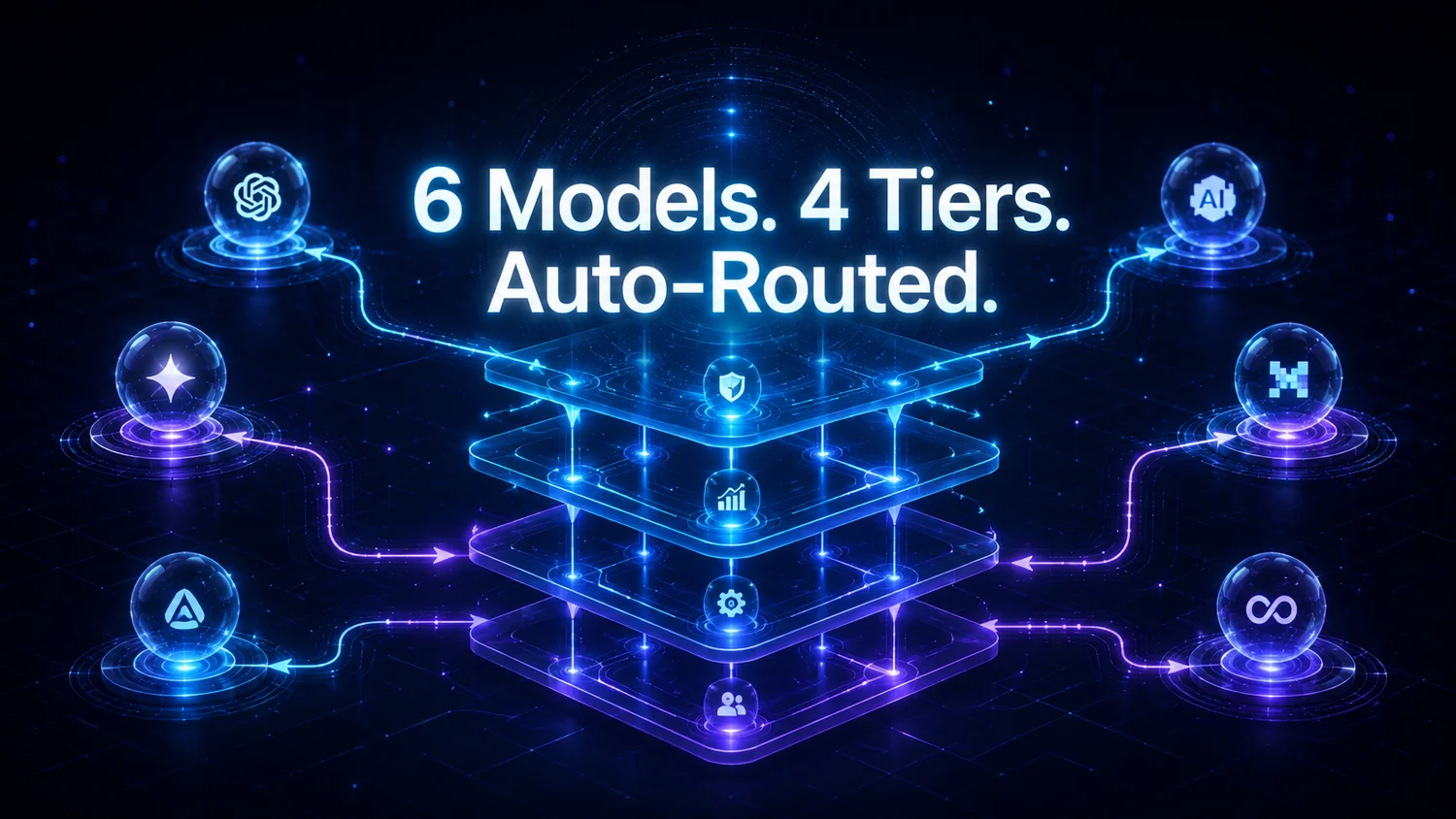
6 Models. 4 Tiers. Auto-Routed.
Every task flows to the right model for cost and quality — Opus 4.8, GPT, Gemini, DeepSeek, Grok & Perplexity.
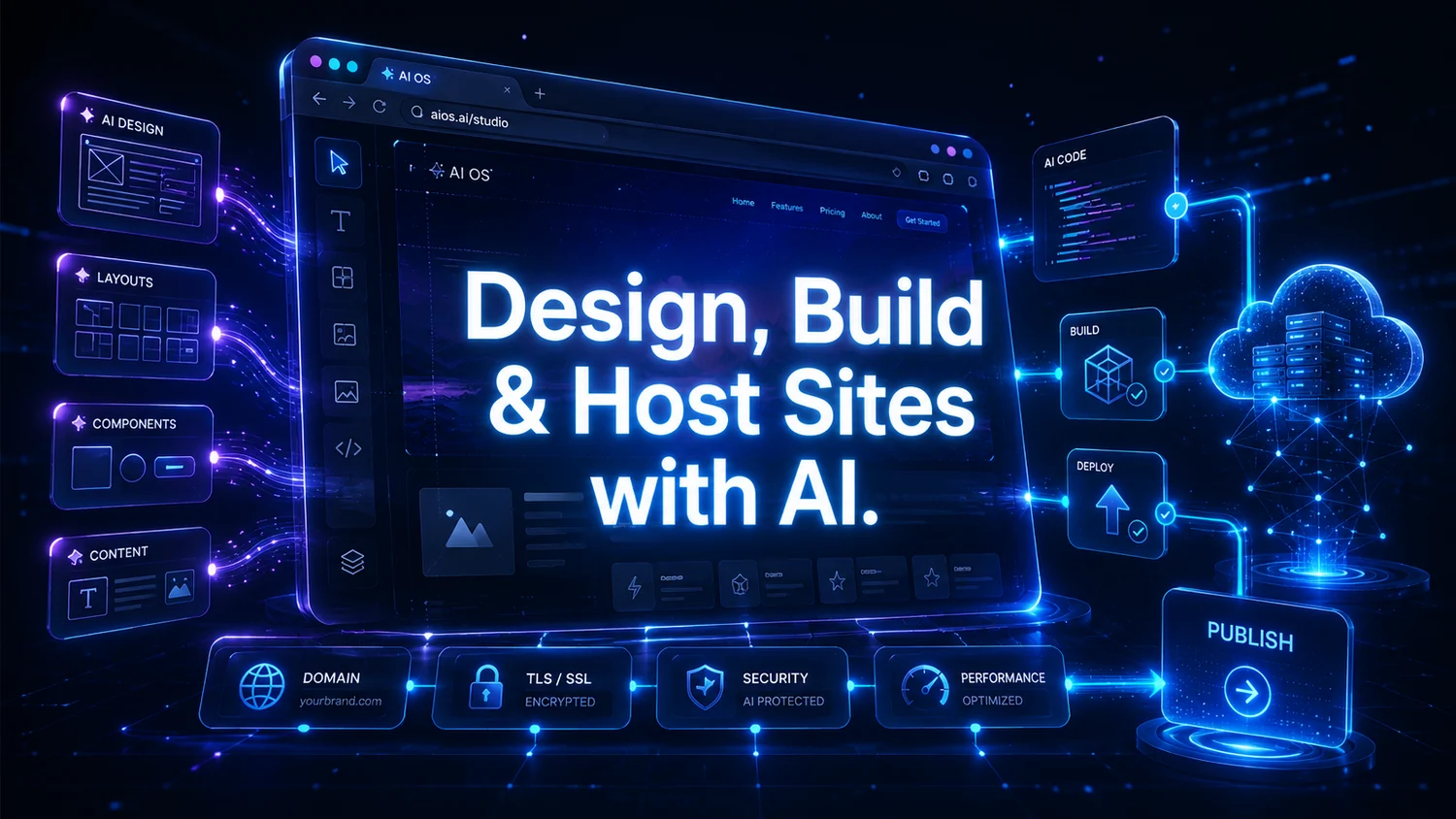
Design, Build & Host Sites with AI.
AI Web Studio ships production sites to your domain with automatic TLS — security-scanned before they go live.
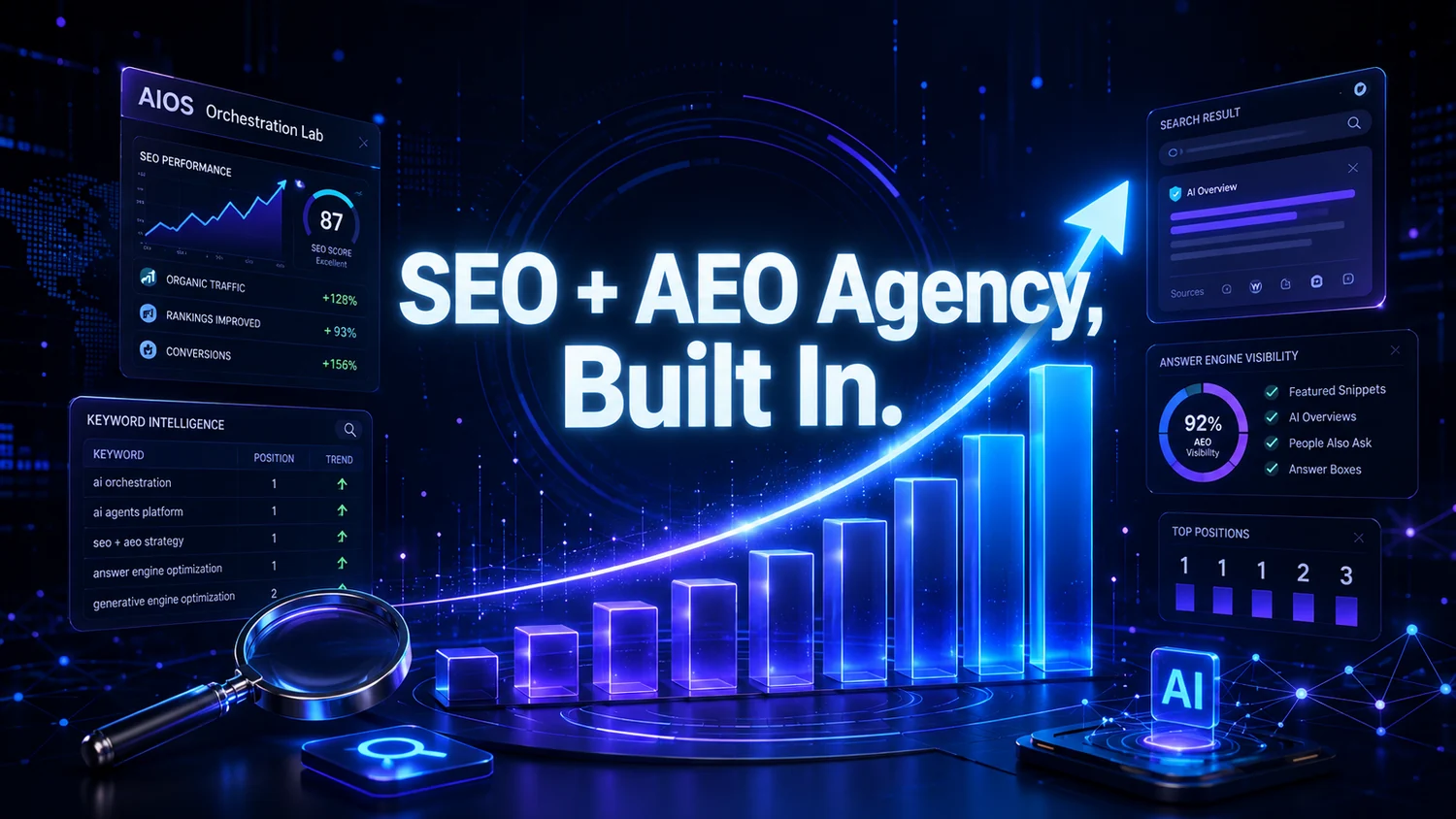
SEO + AEO Agency, Built In.
Comprehensive audits plus an answer-engine readiness score for ChatGPT, Perplexity & Google AI Overviews.
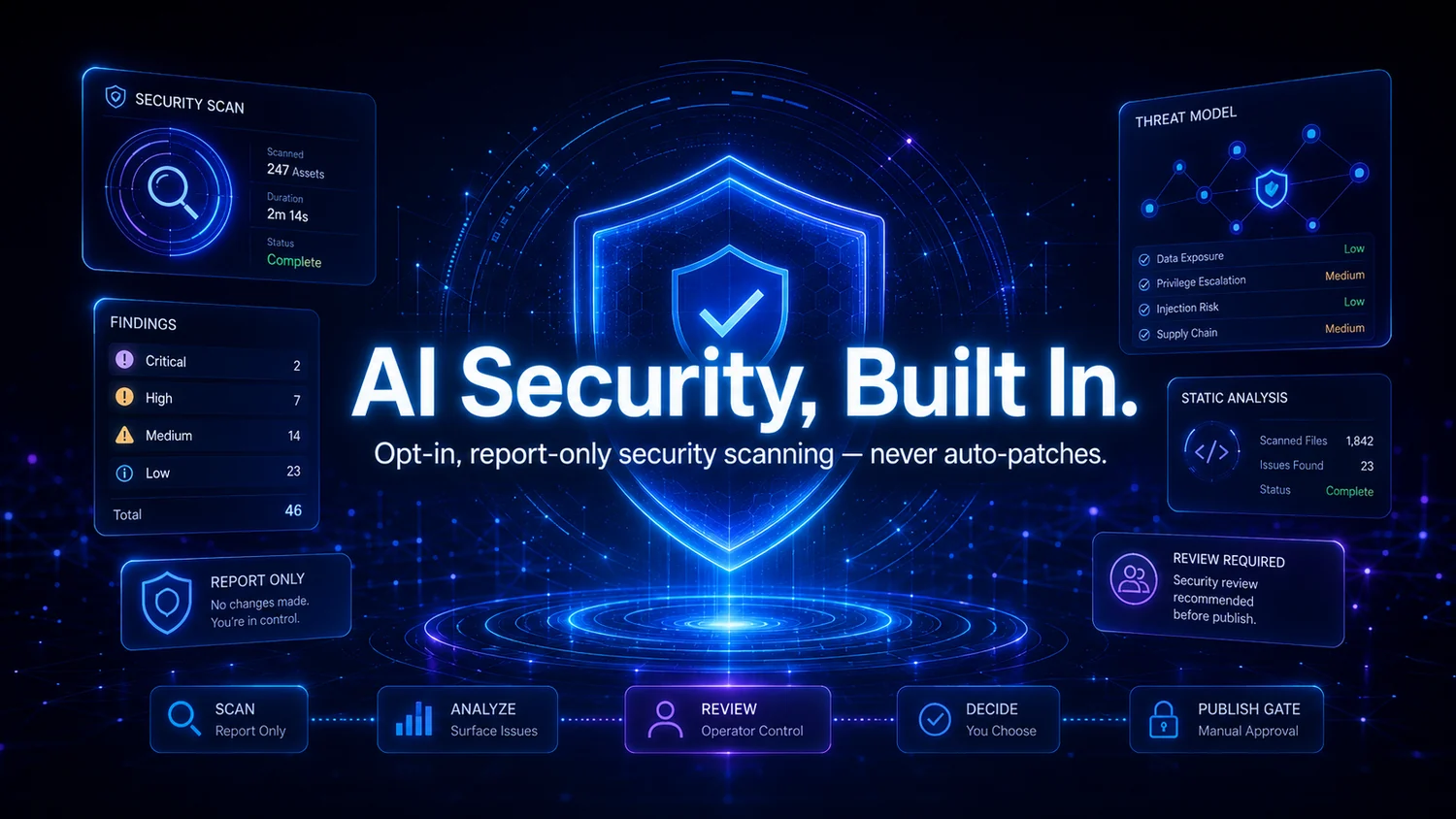
AI Security, Built In.
Opt-in, report-only scanning of your platform and the sites it builds — it surfaces findings, never auto-patches.
66 AI agents across 10 departments — from C-Suite to Legal to Creative Studio.
Research, create, analyze, scrape, monetize — your virtual company works while you stay in control, with human-in-the-loop approval on every important action.
AI OS is an open-source, self-hosted Virtual Corporate Headquarters with 66 AI agents across 10 departments. It is powered by 6 AI models across 4 routing tiers, including Claude Opus 4.8, OpenAI GPT, Gemini, DeepSeek, Grok (xAI), and Perplexity. Key features include an SEO + AEO Agency (audits plus AI-answer-engine readiness for ChatGPT, Perplexity, and Google AI Overviews), an AI Web Studio that designs, builds, and hosts sites — with sales funnels, dynamic pages, lead-capture forms feeding a built-in CRM, and a per-site business dashboard — first-party analytics that track the AI crawlers Google Analytics cannot see, YouTube Video Intelligence, and a Legal department. The Community edition is free. Business licenses start at $1,997 one-time, and a done-for-you Managed Website is $997 one-time setup plus $250/month. You bring your own API keys and deploy on your own infrastructure.
Powered by
Claude Opus 4.8OpenAI GPT-5.6Gemini OmniDeepSeek V4Grok 4.5Perplexity SonarManusFirecrawlTavilyApifyHermes MCP
The Problem
AI Implementation Shouldn't Be This Hard
Every business wants AI, but the path from curiosity to production is full of landmines.
🤯
Which LLM Do I Even Use?
Claude, GPT, Gemini, DeepSeek, Grok, Perplexity, Manus — there are dozens of models, each with different strengths, pricing, and rate limits. Choosing wrong means overpaying for simple tasks or underpowering critical ones.
AI OS solves this: Automatic multi-model routing sends each task to the optimal model. Strategic decisions go to Opus 4.8 xhigh, creative work goes to Gemini Omni, bulk processing goes to DeepSeek. You don't pick — the orchestrator does.
🚀
AI Moves Too Fast to Keep Up
New models drop every week. Opus 4.8 just launched. Gemini Omni shipped last month. By the time you integrate one, three more are available. Your stack is outdated before it's deployed.
AI OS solves this: The platform self-improves. When new models launch, the system proposes upgrades via Telegram or Slack. You approve with one tap. Model swaps are config changes, not rewrites.
🛠
Building Agentic Workflows Is Engineering-Heavy
Orchestrating multiple AI agents that communicate, hand off tasks, escalate decisions, and track costs requires months of development. Most businesses don't have the engineering team to build this from scratch.
AI OS solves this: 66 pre-built agents across 10 departments with escalation paths, cost tracking, and inter-agent routing — all configured via Markdown files. No custom engineering required.
😵
Overwhelmed — Where Do I Even Start?
The sheer volume of AI tools, frameworks, APIs, and approaches is paralyzing. You know AI could transform your business, but the gap between "I should use AI" and "AI is working for me" feels insurmountable.
AI OS solves this: Clone the repo, run the install script, enter your API keys, and your Virtual Corporate HQ is live in 5 minutes. 66 named AI employees are ready to work. Start with an SEO audit or dispatch a task to your CEO — Atlas handles the rest, with your approval on important actions.
Capabilities
Everything an AI Team Needs
Three phases of intelligence — from core operations to creative production to AI-assisted monetization, with you approving the actions that matter.
Phase 1 — Core Intelligence
🛰
Knowledge Graph
Auto-categorizing knowledge base with semantic connections. Sources flow into wiki, outputs, and a visual radial graph.
🎨
Design System
DESIGN.md protocol with dual-structure format — reasoning + tokens. WCAG linter, brand cloning from URL, cross-platform export.
🧍
Business Clones
A replica of one person’s voice, expertise and limits, built by interview on a shared company profile. It drafts in their name, can direct agents under gated limits, and never sends anything itself.
🎥
Media Production
Remotion video, Google Vids, and Blender 3D — all from natural language prompts with template-driven pipelines.
AI-generates digital products — spreadsheets, Notion templates, toolkits. Published to Etsy and Gumroad with SEO listings.
🎯
Lead Generation
Automated scraping, enrichment, and achievement discovery. Personalized outreach referencing specific accomplishments.
📍
Local Prospecting
Find local businesses on Google Maps in any niche and score them for website-upgrade fit — no-website businesses surface first. API-based, never scraped; prospects flow into the CRM in one click.
💌
Email Nurture Sequences
New leads auto-enroll in AI-drafted, human-approved email sequences. Unsubscribe compliance is built in; sends respect your approval mode. Bring a Resend key or any SMTP server.
📅
Appointment Booking
Your generated sites take real bookings against your availability. Visitors get confirmation emails with calendar invites; every booking lands in the CRM.
📊
CRM Pipeline Kanban
Drag contacts through lead, audited, onboarding, and customer stages. Every move is logged on the contact’s timeline — a full audit trail, not just a board.
📣
Marketing Hub
End-to-end content pipelines — source material transforms into multi-platform distribution across 5+ channels.
🔗
Golden Loop
Connects Gemini Gems to NotebookLM notebooks. Your AI expert always has the latest research and documentation.
Phase 3 — Creative Studio & Intelligence
✨
Gemini Omni Studio
Video, image, audio, thumbnails, and social clips from text prompts. Powered by Gemini Omni Flash with SynthID watermarking.
🔍
SEO Agency
7 parallel sub-agents audit any domain — keyword, technical, competitor, content, backlink, AEO, and Local SEO / Google Business Profile — with composite scoring and action plans.
🎥
YouTube Intelligence
Claude Vision reads video frames + transcripts together. Extracts what speakers show, not just what they say.
⚡
Batch Queue
Mass content production using economy-tier agents. Build massive A/B testing libraries at a fraction of the cost.
66 named AI employees across 10 departments — C-Suite, Engineering, Marketing, Creative, Legal, Support, IT, and Operations.
⚖
Legal Department
General Counsel, Compliance Officer, Licensing Attorney, and Contract Specialist handle agreements, compliance, and IP protection.
🏠
Self-Hosted & Private
Business and Enterprise licenses include self-instance theming — your company name, logo, and colors on your own dashboard. Self-hosted on your own infrastructure, for a single customer.
📈
Predictive Analytics
AI-estimated forecasts for revenue, engagement, costs, and churn with confidence scores and factor analysis.
🧠
Self-Improve (Grok Build)
An agent reads AI OS's own code and plans upgrades — applied to your instance or proposed as a draft GitHub PR against the public repo. Every apply and every PR always requires your explicit approval.
Security & Trust (Opt-In)
🛡
AI Security Self-Assessment
STRIDE threat-model + semgrep static analysis + an AI blue-team review loop, on demand or scheduled, from an operator Security dashboard. Report-only — it surfaces findings and never auto-patches the live system.
🔐
Publish Security Gate
Every generated or imported site is security-scanned before it goes live — configurable off / warn / block — so risky output never reaches a live domain unchecked.
🧪
Managed-Client Security
Per-client security assessments recorded as a CRM deliverable and surfaced in the client's own Site Security workspace view.
Phase 5 — Platform Expansion (Roadmap)
📱
Mobile App / PWA
Progressive Web App with offline support, push notifications, and native-feel experience on iOS and Android.
🔌
Webhook Marketplace
Browse and install pre-built webhook integrations — Zapier, Make, Slack, HubSpot, Salesforce, and hundreds more.
🧩
Plugin / Extension System
Build and share custom agent tools. A typed SDK lets developers extend any agent with new capabilities and data sources.
📲
Mobile Companion App
Enterprise customers get a branded mobile app for their own instance — your icon and your colors. Powered by AI OS under the hood.
📊
Advanced Reporting
Scheduled PDF and CSV reports delivered to your inbox. Custom dashboards, date-range comparisons, and executive summaries.
🎥
Multi-Agent Meetings
Real-time roundtable conversations with your AI employees — bring in multiple agents at once to debate, brainstorm, or work through a decision together.
Under the Hood
6-Layer Agentic Architecture
Every layer is modular — swap models, add agents, chain skills, all without touching core code.
01
Knowledge & Memory
Vault system with raw intake, synthesized wiki, and semantic search. Session hooks auto-load context.
Enterprise license includes 1 year of priority support, custom agents, and target response times. Optional annual renewal at $997/yr to extend priority support.
Don't want to self-host? We do it all for you. Our AI agents and team design and build your site, then we host and maintain it on our own VPS — custom domain, TLS, and ongoing updates included. You get a scoped client dashboard to track your site, audits, and content. It's the same platform, fully managed.
✅ We build & host on our VPS — nothing for you to run
"Replaced three separate SaaS tools with one AI OS dashboard. The cost tracking alone saved us hundreds per month."
JM
James M.
Solo Founder, SaaS
"The effort-based routing is genius. Opus 4.8 xhigh for architecture decisions, low effort for monitoring, DeepSeek for bulk work. Costs stayed under $5/day."
SK
Sarah K.
AI Engineer
"The lead gen pipeline found 200+ qualified prospects in an afternoon. Each outreach message referenced their specific achievements."
RP
Ryan P.
Growth Lead, Agency
FAQ
Frequently Asked Questions
AI OS is a Virtual Corporate Headquarters — an open-source, self-hosted AI operating system with 66 specialized AI agents across 10 departments that routes every task across 6 AI models in 4 effort tiers (Claude Opus 4.8 by default, plus OpenAI, Gemini, DeepSeek, Grok, and Perplexity). It bundles an SEO + AEO agency, an AI Web Studio that builds and hosts sites (with funnels, dynamic pages, and lead-capture forms), first-party AI-signal analytics that show the AI-crawler traffic Google Analytics cannot see, a CRM with a per-site lead inbox, content provenance, and an opt-in AI security suite. You bring your own API keys and run it on your own infrastructure.
Community is free and open-source (self-hosted). Business is a $1,997 one-time license; Enterprise is $4,997 one-time, with an optional $997/yr renewal for continued priority support. Prefer hands-off? The done-for-you Managed Website service is $997 setup + $250/month. Because of the BYOK model, you pay your own AI providers directly — there is no markup on token usage.
Community (free, open-source) gives you 15 agents across 5 departments — ideal for personal use and small teams. Business ($1,997 one-time) unlocks all 66 agents, all production tools, and self-instance theming to white-label your own private instance. Enterprise ($4,997 one-time) adds everything in Business plus SSO/SAML, advanced security, a visual custom-agent builder, and 1 year of priority support (optional $997/yr renewal).
Yes. If you would rather not self-host, our Managed Website service ($997 setup + $250/month) builds your site in AI Web Studio and hosts it on our VPS with a custom domain and TLS. You get a scoped client dashboard with your sites, your SEO/AEO audits, and your Site Security report — no infrastructure to run.
A clone is a replica of one specific person — their voice, their expertise and their limits — built by interviewing them rather than filling in a form. It drafts work in their name and can commission research or writing from the agent fleet, but it is draft-only: nothing is sent without a person approving it. Clones are built on a company profile that comes first and that every clone inherits, so nobody is interviewed about the business and every question is about the person. Limits are per instance: one clone on Community, ten on Business, twenty-five on Enterprise.
No. Day-to-day use is through the dashboard — you describe goals in plain language and the agents execute. Self-hosting takes a one-time install (clone, run the install script, add your keys), and the Managed Website service removes even that. Custom agents are simple Markdown files — no programming required.
Yes. AI OS uses a BYOK (Bring Your Own Keys) model — you enter your own keys for Anthropic, OpenAI, Gemini, DeepSeek, xAI/Grok, and others in Settings. This gives you full control over spend and rate limits with no markup, and the dashboard tracks every token across all models in real time.
6 AI models across 4 routing tiers: Claude Opus 4.8 (the default, with effort-based routing), OpenAI GPT, Gemini, DeepSeek, Grok (xAI), and Perplexity. The orchestrator routes each task to the right model for cost and quality — deep reasoning to the strongest tier, bulk work to the economy tier, and live search to the real-time tier.
Yes. Agents are Markdown files with YAML frontmatter — drop one in .claude/agents/ and the system picks it up immediately. Enterprise includes a visual agent builder for creating and editing agents from the dashboard.
Yes — that is the AI Web Studio. Describe your site (or import an existing one) and the studio's agents design, build, and deploy it on the VPS with a custom domain and automatic TLS. Every site can be security-scanned before it goes live, and generated sites are built to pass AI OS's own AEO readiness checks.
It runs comprehensive SEO audits with 7 parallel sub-agents (keyword, technical, competitor, content, backlink, AEO readiness, and Local SEO/Google Business Profile) that measure everything from organic rankings to how well AI answer engines like ChatGPT, Perplexity, and Google AI Overviews can parse and cite your content, to local-pack visibility for local businesses. It improves your readiness and gives a prioritized action plan — but, honestly, no tool can guarantee citations or rankings.
AI OS hardens the app (Helmet, CORS, rate limiting, input validation, bcrypt password hashing, and human-in-the-loop approval gating for risky actions) and adds an opt-in, report-only AI security suite: it can self-assess the platform (STRIDE + semgrep + an AI blue-team), scan every AI-built site before it is published, and deliver security reports to managed clients. It surfaces findings and never auto-patches your live system — an AI-assisted capability, not a guarantee.
Yes. AI OS is single-customer and self-hosted, so your data stays on your own infrastructure. Your API keys, audit results, settings, and user data never leave your server, and API calls go directly from your instance to your configured providers using your own keys.
Yes. Business and Enterprise include self-instance theming — brand your private instance with your own name, logo, and colors. Enterprise adds custom agents and SSO/SAML for a fully branded, team-ready deployment.
Community is community-supported (GitHub Issues, best-effort). Business includes standard support. Enterprise includes 1 year of priority support with faster response times, renewable at $997/yr. Managed Website clients get ongoing maintenance as part of the $250/month.
Ready to Deploy Your AI Fleet?
Join builders who are automating research, content, leads, and monetization with multi-agent intelligence.